Tool of the Month
gear blog
gear blog  
 
step by step
self generating
 

NAMM News: IK Multimedia’s Amplitube 3

Since its first appearance, Amplitube has been one of the most popular guitar (and later bass) amplifier emulation plug ins. We remember getting a light version of Amplitube 1 bundled with our first M-Box (circa 2000). This initial plug-in was a neat, simple program with a few options, but when we saw version 2 our jaw dropped: many classic amps, pedals and cabinets were recreated beautifully in both the audio and graphic departments. Extra options related to cabinet miking (choice of type of microphone, on or off center placement and mic distance from the amp) sweetened the deal even further. IK Multimedia presented Amplitube 3 at NAMM, and it looks like the main focus in developing this new version was to expand the selection of emulated hardware: AmpliTube 3 has nearly 100 more gear models than its predecessor, including about 70 top amp and effects models from AmpliTube Metal and AmpliTube Jimi Hendrix.

One of the most interesting new features is the new cabinet module. Sporting a redesigned GUI, not only can you mic and mix each cabinet with 2 microphones, but the microphones also can be freely moved around the speaker, making it easier to find that magical sweet spot. Cabinet “size” can now be also controlled so you can enlarge and shrink your cabinet beyond the limits of the physical world. In addition, you can adjust the room ambience and room mic positioning for an ultra-accurate modeling of the cabinet in the natural recording space.

Interesting news on the effect side of things too: AmpliTube 3 also includes new effects not found in other modeling packages such as StepFilter, StepSLicer, TapDelay, Rezo and Swell in both stomp and rack versions. There’s also a 3 speaker cabinet module that contains a very cool rotary speaker based on a model of a vintage Leslie 147. Largely as a result of requests fom AmpliTube users, you can now reconfigure your pedal board and rack effects chain simply by dragging & dropping an effect into its new position.

Another interesting feature is that Amplitube 3 is now expandable: you can now add individual pieces, or entire collections like AmpliTube Fender™ or Ampeg® SVX. This will also allows you to purchase “singles” on an as needed basis in the future, and have them all available in one plug-in from within the AmpliTube 3 structure.

January 29th, 2010 | No Comments »


Guitar Pedal Review: Malekko’s Barker Assmaster

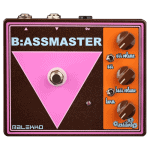
The Barker Assmaster from Malekko Heavy Industry is a hand built clone of the Maestro Bass Brassmaster harmonic octave fuzz. This updated version supplies the same classic fuzz tones as the original in a modern, rugged and reliable package. Although aimed at bassists, this pedal performs equally well on guitars and even synthesizers. The three knobs control the effect level, the attack of the fuzz (Ass Volume and Sensitivity, respectively) as well as the level of the original, dry signal (Bass Volume). In addition, there are two toggle switches affectionately dubbed Ass and Harm. These controls act in conjunction with one another allowing the user to thin out the fuzz or unleash it on unsuspecting eardrums. True bypass switching keeps your sound clean and unaffected when you decide to take a break.In practice, the Assmaster becomes fiendishly easy to cop bass sounds that could please any fuzz freak. Rolling back on the Sensitivity knob keeps the Assmaster on its best behavior, yielding controlled fuzz perfect for that vintage vibe. Roll it clockwise and things can get crazy fast. Industrial and metal fans rejoice – this pedal delivers! No matter how freaky your fuzz, the clean blend allows bassists to keep one foot in the pocket or boost the clean volume to drive the front of your amp or other effects as well. Additionally I would like to say that using the Assmaster in conjunction with a cranked SVT rig sits somewhere on the border of sublime and downright dysfunctional.With its bright pink and brown sparkle appointments the Assmaster may raise some eyebrows but this pedal is dangerously fun and addictive, not to mention very well made. If you are looking for a bit of fuzz this is one to check out. – Arthur Fleischmann

January 23rd, 2010 | No Comments »


Deli Video Review of OktavaMod MJE-K47H

January 22nd, 2010 | Comments Off


Pedal Review: Devi Ever’s Eye of God

Devi Ever is creating effects unlike most we’ve ever seen. Based out of Portland this one-woman show is breaking new ground with every product she produces. The Eye Of God, a feedback loop equipped with a light sensing photo eye, is no exception. Although it produces no sound of its own the EOG can turn your existing stomp boxes into a brand new, tone-creating palette. Quality parts including true bypass switching make this device feel well made, despite being smaller than a standard “Boss style” effect.

Unlike normal effects with only input and output jacks, the EOG features send and return jacks as well. Using a standard guitar cable connect the send to the input of the desired effect(s) and another from the output to the return. Stepping on the EOG’s stomp switch activates the loop. A knob label Control alters the intensity of the feedback. The results are reliant on what ever pedals you connect. Drive effects such as distortion and fuzz often emit a tunable feedback. Delay and reverb effects cascade on themselves creating pulsing waves of noise. When things get loud the Volume knob controls the master level . Toggling the switch on the side of the unit activated the photo eye. This senses the amount of light and adjusts the intensity of the effect as well, giving the operator hands free control over the chaos. The EOG reacts differently with each pedal and also changes the function on the controls of the pedals in its loop. Sadly while the EOG is deactivated so are the pedals in its grasp so you won’t be able to use them normally. In the end experimentation is key. Looking to breathe new life into your old, stale effects? The Eye Of God could be it. - Arthur Fleischmann

January 22nd, 2010 | Comments Off


The Martini Analog Chorus

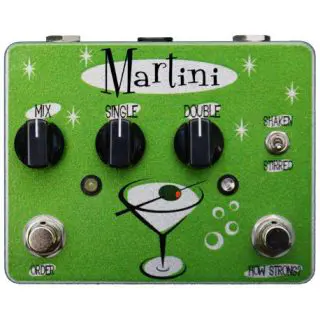
In the contemporary boutique effects community, the hippest stomp-boxes offer bizarre and unprecedented ways to thoroughly dismember one’s guitar signal. Conversely, traditional effects like phasers and vibratos have become about as sexy as huge crimped hair and shoulder pads. The chorus pedal, like the floyd-rose tremolo and 12-string bass guitar seem to have been excommunicated from the Church of Cool.Tortuga Effects, a hot new stomp-box company, enjoyed early success with products such as the Sasquatch, a fuzz device with a second channel that makes one’s guitar howl like a lovesick Bigfoot. Founded by Seattle high-end gear guru Matt Johnson, Tortuga is putting its cool-cache on the line with their first chorus pedal, the Martini. Influenced by the boundary-bending irreverence of the Sasquatch, the Martini stirs up the classic sound of traditional chorus by acting as two distinct pedals in one, with two speed controls that can be switched on the fly. The “order” button turns Martini on, and “how strong?” switches between the “single” and “double” channels. The latter can switch between “Shaken” (chorus) or “Stirred” (vibrato) modes. Powered by a standard 9v wall wart, the hand-made pedal features obsessive construction quality and true-bypass switching, so it will not affect tone when disengaged.From The Police’s plinkyness to swampy Nirvana sludge, I found every classic chorus sound in the unit. Doubling distorted solos with a chunky chorus setting yields an unbelievably thick lead sound. Riffs become more gut-wrenching. At a list price of $299, the dual-channel Martini packs more value than single-channel boutique offerings like the Empress Chorus by Redwitch, and industry staples like the Stereo Chorus/Flanger by TC Electronics and Chorus XII by Carl Martin. If you have a shy, sober guitar sound, the Martini is the perfect sonic social lubricant. - by Ben Wigler

January 22nd, 2010 | Comments Off


Plug In Review: Stillwell’s CMX Micro Shifter

As a big fan of Stillwell Audio plugins, I was eager to try the new stereo pitch shifter in Stillwell's Schwa line of time based plugin effects. Upon installing the plugin, the first thing I noticed was the sleek and interesting graphics that they incorporated with this ...

January 22nd, 2010 | Comments Off


Interview with engineer/producer Jay Braun

When you look at Jay Braun’s bio, you get the sense that he likes his music honest and raw. Which recent artists do you think of when you hear those adjectives? Maybe John Spencer Blues Exlplosion? (Jay’s worked with them). How about Mooney Suzuki? (Jay’s been known to pick up ...

January 22nd, 2010 | Comments Off


Guitar Pedal review: Harmonic Percolator

Boutique distortion pedals are a lot like New York City bagels: everyone seems to make them, and everyone seems to claim his or hers is the best. The Chuck Collins Harmonic Percolator makes no outlandish statements about being number one, but for any fan of the Steve Albini/Big Black tone, ...

January 22nd, 2010 | Comments Off


Oxford Sonnox SuprEsser plug in Review

The Sonnox Oxford Supresser is a simple yet highly flexible de-esser and dynamic EQ. At first glance, this plugin appears to be similar to the built in de-essing plugins that come with Logic or Pro Tools. When inserted on a vocal, it can easily handle duties of suppressing harsh high end frequencies that are often created when using cheap Chinese made condenser microphones. Without much hassle, the Suppresser can be set to natural tame a poorly recorded vocal in seconds.This plugin really shines in handling other sources as well. I recently had a mix session where the snare drum was recorded very poorly. There was a lot of high hat bleed coming in to the snare mic. This made it very difficult to properly compress the snare. I used the Supresser to dynamically duck the high hat hits at 5 khz while retaining the punch and the crack of the snare. This allowed me to compress the snare after the Supresser without creating a washy hi hat.Another useful feature of the Supresser is the listen modes. The user can easily monitor what is being compressed as well as what is not being compressed. This makes honing in on certain problematic frequencies a breeze. A final feature that I suggest all plugin manufactures include is a blend control. The user can blend the de-essed signal with the dry signal for a very natural tucking of the hard frequencies, without destroying the original intent of the performance. - by Shane O'Connor

January 22nd, 2010 | Comments Off


Guitar Pedal Review: Malekko’s Barker Assmaster

The Barker Assmaster from Malekko Heavy Industry is a hand built clone of the Maestro Bass Brassmaster harmonic octave fuzz. This updated version supplies the same classic fuzz tones as the original in a modern, rugged and reliable package. Although aimed at bassists, this pedal performs equally well on guitars ...

January 22nd, 2010 | Comments Off


pic
The Sundelles
cali rock meets velvet underground
by Lauren Piper - MORE
Chappo
shaking things up
by Christina Morelli - MORE
Freelance Whales
gentle hotel destroyers
by Michael D. Spencer - MORE
Tony Castles
storming the castle
by Dean Van Nguyen - MORE


  gear blog

1. Recording: Home vs Studio
  the question is: can YOU do it?
Indie producer/musician Bruce Kaphan (R.E.M., David Byrne, Red House Painters, American Music Club) analyzes pros and cons of recording the DIY way - read the article.
2. Choosing a Recording Studio
pick carefully + things to consider
What do you need to look for in a recording studio? In this article you'll find all the advice you need about equipment, engineers, rooms, rates, and ways of approaching the recording experience. - read the article.
3. Planning Recordings
be prepared, have a budget
Steven Alvarado, a NYC studio manager provides precious advice on how to approach the recording of your CD. "When you enter the studio, have a plan. Map out what you want to accomplish each day so that you have a realistic idea of how much time you will need to complete your project. It's best to be as prepared as possible." - read the article.
4. Do You Need a Producer?
and: don't waste studio time!
Making a recording is a tangle of pragmatism, technology, alchemy and faith. As is the case with any creative venture, you cannot know what you'll get for your efforts until you go through the process; it's always a gamble. Having a plan and a budget can be really useful. - by B. Kaphan - read the article.
5. Drums in the Studio
performance and recording tips
Drummers shouldn't miss this article! 4 Top NYC producers answer our questions on how to perform, hit, and tune the drums in recording situation. And... is your drummer tight and can he/she play to the click? - read the article.
6. Recording Vocals
not as easy as you might think
Recording vocals might not seem alike the most challenging task when producing a CD, but this delicate and crucial process often ends up being quite draining and taking longer than expected - - read the article.
7. Do You Need Mastering?
what it is and why it is!
Mastering is a process that not many emerging musicians are fully familiar with. One of the most succesfull NYC mastering engineer tells us all about this "secret" art.- - read the article.

  gear blog

Career Survival Guide
it's not just about the music
A music carreer IS all about surviving - at least in the early stages. This survival guide will help you think of different ways to keep your focus on building your brand and creating a path for success. If you think of yourself as your own small business, then the following information can become your personal marketing plan. - read on. - courtesy of BMI.
Do You Need a Manager?
sharing the load - at what price?
Most bands that succeed beyond the local level eventually do so with the aid of a manager. What does this person do, aside from collect a healthy cut of the money? We interviewed 2 NYC managers and 1 publicist with different experiences in the local scene to help us understand. - read the article.
College Radios
what can they do for your band?
In this day and age, we should be thankful that college radio still exists. While commercial frequencies pump the same boring playlists into every city, college radio provides unique, local voices to the airwaves and internet. - read the article by Liz Schroeter here.
Protect Your Band's Name!
the name is what you are selling
The reputation and recognition of an artist's music is built around the artist's professional name, which is what consumers use to identify the artists they enjoy. Therefore, an individual artist or group pursuing a career in the music industry should take the necessary steps to protect his, her or its professional name. by Christopher R. Chase, Esq. - read the article.
Routes to Success
that way you don't get lost
An interactive guide to 3 ways to approach your adventure in the music industry with links to listings and articles. - read the article.
 
review