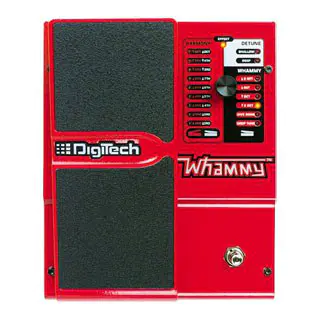
Few guitar-pedal manufacturers design a transcendent product that becomes a true classic that redefines the capabilities of the instrument. When such a product is embraced by the market, it not only defines the brand, but casts its shadow over the entire spectrum of competitive devices. For many, the Ibanez Tube-Screamer defines guitar overdrive, and the EHX Big Muff defines thick sludgy fuzz. Since 1991, the field of pitch-shifting effects has been dominated by the DigiTech Whammy; an effect that allows users to perform dive bombs and radical octave-shifts using digital pitch-manipulation rather than a guitar-mounted vibrato-bridge. The pedal opened a huge new range of playing options and has been a core tone component of guitarists as diverse as Steve Vai, Tom Morello, Jack White, and Dimebag Darrel, who each found radically different uses for the device. More recently, indie guitarists such as Peter Silberman of the Antlers, have used the pedal to create lush, ambient guitar universes for contemplative songs to dwell in.
But in the last decade or so, DigiTech’s Whammy has been given a run for its money by newcomers in the pitch shifting market. EHX’s POG and HOG technology has arguably taken the grand prize, offering truly polyphonic (ie. true relative string pitch across all 6 strings) pitch and octave shifting with less tone-sucking design quirks, with build quality, price point and feature sets that have attracted a new generation of tone tweakers. Eventide’s Pitchfactor upped the ante further by offering pitch bending of actual samples (EHX pedals use synthesized notes, not your actual guitar sound), midi control, and true bypass. The Pitchfactor and HOG also have Whammy-like settings that shamelessly chase after the classic DigiTech effect.
While DigiTech’s recognizable brand and classic design could keep the pedal alive and well, the company is unsatisfied with a product that does not dominate its competition. The DigiTech Whammy-DT is a product that addresses virtually every other feature of its competitors head-on at a price point that gives it the clear edge. The Whammy-DT brings the classic effect up-to-date with a fantastic true bypass, the ability to control the unit via midi (with a Source Audio midi-HotHand, one could effectively have an invisible vibrato bridge!), and most importantly, polyphonic tuning. The DT stands for Drop Tune, and is marketed to go after precisely one competitor: Morpheus FX, whose new-kid-on-the-block Bomber pedal has become a big hit with heavy guitar players such as Brent Hinds of Mastodon.
For the purposes of this review, I put the Whammy-DT head to head with the HOG’s whammy function, the Morpheus FX capo pedals, and the whammy and low octave settings of Pigtronix’s analog synthesizer, The Mothership.
To be clear – the DigiTech does everything the Morpheus pedals do, and then some, with better build quality, and more resale value; albeit for a couple of sheckles more upfront. Sonically, I found that there was no noticeable difference between the “capo” type effects of the Morpheus line, and that of the DigiTech. I play in several bands and am often bringing guitars that are dropped a whole step to a show that I need to be playing in standard tuning. As a result, I’m often the guy who is always tuning in between each song to keep my strings from going wonky on me. I have to say that digital technology has gotten to the point where either the Morpheus or the DigiTech would allow me to play through drop-tuned set with a guitar in standard tuning. I found that the tonal integrity was a bit stronger when using the units to tune a guitar down, and that “capo’ing up” yielded sonic artifacts that a truly OCD tone geek wouldn’t be pleased with. However, through a cranked Fender bassman goosed by a TC Electronic MojoMojo, no one seeing my band at Piano’s is ever going to know that I’m using a device to tune down. For my dollar, I prefer the DigiTech because it will hold its value better, and I feel silly having a pedal on my board that shares the name of Laurence Fishburn’s character from the Matrix. I also really like the color red.
The whammy feature on the EHX Hog doesn’t touch the Whammy-DT’s dive-bombing abilities, but the EHX’s freeze & glissando effects are stunning, and its low and high-end synth tones are clearer than the Whammy’s manipulated audio samples. The Pigtronix Mothership’s whammy is similarly flat in comparison, but its analog sub-low output blows the doors off the low end of the Whammy-DT. Both EHX and Pigtronix pedals have features the Whammy can’t match head-on, but the clumsy bulk of a full HOG rig will keep it off a grab-and-go pedalboard, and the Mothership’s mono voice is much better suited to bass guitarists who want a cool analog synth.
The Whammy DT stands up to the rigors of air and road travel beautifully. My dear friend Clifton Hyde (Blue Man Group, Gato Loco, session extraordinaire) recently went on tour through Germany with the Whammy DT and said “it did everything I could want it to do.” Hyde toured for years with a tremolo-equipped PRS, but has become a recent convert to stop-tailed Les Pauls. Hyde used the pedal “almost exclusively for dive bombs,” and noted that the pedal worked better than anything he had tried. While Hyde didn’t delve deep into detune settings, he mentioned he did use the pedal to cop tones like Adrian Belew’s deliciously weird sounds on the Brian Eno-produced Talking Heads’ Remain in Light record. “The whole band loved it.”
Whether you’re looking to create beautiful sounds that transcend typical guitar tones, dive bomb like a revving Harley-Davidson, or simply avoid tweaking the pegs of your downtuned tele every two seconds, the DigiTech Whammy DT is a serious piece of music technology. Rugged, versatile, expandable, and very easy to use, the Whammy-DT is a smart investment for the working guitar player or bassist who wants to step way outside the bounds of what is physically possible with their analog instrument. – Ben Wigler