


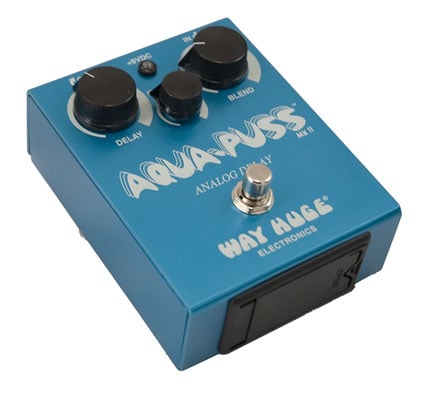
Today’s focus is on the Way Huge Electronics Aqua-Puss mkII Analog Delay which is a reissue of the original Aqua-Puss. The original is very rare and has been known to command quite the premium on eBay and in used guitar shops. Way Huge Electronics is a company that was resurrected in the last few years and is now distributed by Dunlop Manufacturing with Jeorge Tripps still at the helm. The company has a full line of pedals and the original and vintage looking quirky lettering and colorful cases are still intact.
The first thing I noticed was an interestingly illustrated box. Many black and white cartoons of aliens and strange creatures greet you as you get to the goods – definitely an exciting, unexpected start. As I took out the contents I also noticed lots of Way Huge swag including buttons and stickers.
Things that I look for in an analog delay pedal: warm, slightly dark repeats with the ability to be fed back into oblivion when the feedback knob is jacked up all the way. Do you get this with the Aqua-Puss mkII? Yes. Is that all? No. With this delay it’s all about its unique character. I absolutely love the way this pedal sounds when feedback is used in abundance. In between phrases the delay will feedback like crazy but when you play again it calms down. It reminds me of amp feedback. It’s really unique and rad.
As far as controls you’ve got the usual suspects: delay time knob, feedback knob, and blend knob. Everything operates as expected but I noticed that the blend knob is not a wet/dry level control. It simply applies more delay to the dry signal as it is turned clockwise. So at a full clockwise setting you get full delay and full dry. This really helps maintain the integrity of the dry signal even when extreme delay is desired. Where this could cause problems is if, like me, you like to impart analog goodness on your mixer’s effects sends and like to use guitar pedals as aux effects. You would essentially get a double of the dry signal which is typically not desired of an aux effect or fx loop. This leads me to my next topic.
I hardly ever use a pedal on just guitar or bass when I review. I like to see what it does to non-conventional sources such as drum machines, synths, vocals, my favorite songs, etc. Let’s start with guitar though. I started off by running my Agile AS-820 directly into the Aqua-Puss and then into my Fender Blues Junior. I got a beautiful tone that instantly became my favorite rhythm guitar delay. Super warm, super clean, but because of the unique character of the repeats it added this sense of glue to the repeats that just sounded butter. As with all analog delays, when I adjusted the delay time it sounded like I was pitching up and down a tape machine. It really sounded sweet from 20ms all the way to 300. What I didn’t really hear was the whistling that I read of other users experiencing at higher delay times. I expected this and didn’t hear it. I also noticed that the delay repeats seemed a bit darker than that of my old EH Stereo Memory Man. The Stereo Memory Man did have the whistling though. Wonder if there is any correlation?
Next, I wanted to hear what my Moog Little Phatty sounded like with this pedal. It provided a great slap to acidy sounds and made for a great bass fattener. I really liked the way it sounded with those analog oscillators. I was getting some beautiful, liquid tones out of this pairing and probably spent a little too much time in this department. Then it dawned on me that within my iPhone I had another world of sources to test so I turned to the app called Funk Box which is a drum machine/sampler app for iOS. The unique character of the repeats made some of the classic analog drum machines like the Roland TR-606, 808, and 909 sound either too thin or too boomy. However, I discovered a real gem when pairing the Aqua-Puss with Funk Box’s version of the Linn Drum. The lo-fi, “in your face” samples paired with the darker distorted repeats of this pedal were a match made in heaven and I had a blast playing with the delay and feedback knobs.
I really like the Aqua-Puss mkII. I never owned the original so I can’t compare the two, but from what I hear they are pretty on par. The price is very competitive and I would say that if you are in the market for a 300ms analog delay then you should absolutely give this a whirl. I plan to take advantage of the unique repeats and wild feedback swells for my own personal productions. This pedal is a lot of fun! – Gus Green










1 comment
Lon says:
Nov 30, 2020
I used original tape delays in the past and it really comes very close to the old tape slapback that I love . Rockabilly ON.