Tool of the Month
gear blog
gear blog
 
step by step
 

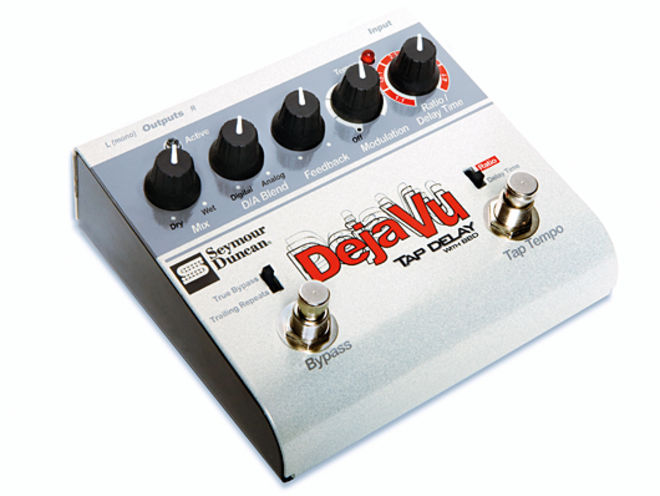
Seymour Duncan Deja-Vu Delay Pedal

With thousands of delay pedals available, not to mention recording plugins, choosing an effect can be overwhelming. Are you looking to add a subtle slapback or an intense rhythmic pattern?

While it’s capable of everything you’d expect from a delay pedal, Seymour Duncan’s SFX-10 Deja Vu Tap Delay truly excels at the latter. Though its sound is not as immediately glowing as an Electro Harmonix Memory Man or controls as eccentric as a Line 6 Delay, the Deja Vu’s strength lies in its flexibility and precision when dialing customized sounds into a live environment.

The Deja Vu contains all the standard delay controls (wet/dry knob, feedback, delay time) with some notable extras. A dedicated tap tempo footswitch with a ratio knob (half note, quarter note etc.) makes it unbelievably easy to adapt complicated delay settings on the fly. Meanwhile, a toggle between a true bypass mode and trailing repeats lets you kill the delay effect while letting the echoes trail off. This allows for adding anything from sweet flourishes to ringing shock waves. Finally, a feedback insert jack lets you apply a separate effects chain to the wet signal, giving you endless possibilities for customization.

Even without using the insert, the Deja Vu has some nice built-in features for shaping the delay’s tone. The pedal has a D/A blend knob which moves seamlessly from a crisp snappy digital sound to warm true-analog echo. The modulation dial moves between a few preset flanging and vibrato style effects (similar to the Electro Harmonix Memory Man). They add some interesting character to the delay, however, they aren’t labelled which is a little confusing at first.

For those who need precision delay, but don’t want to depend on using midi or backing tracks, the Deja Vu is indispensable. Sonically, it holds its own against most high-end delays, with enough tweak-ability to shine in any style of music. – Ezra Tenenbaum

January 17th, 2012 | No Comments »


Leave a Reply


pic
peerless
Hooray for Earth
the "12 pack" recording technique
by Chuck Davis - MORE
Yellow Ostrich
taking chances
by Mike Levine - MORE
Stomp Box Exhibit at CMJ
effect pedals in NYC
by Paolo De Gregorio - MORE
Alberta Cross
a live affair
by Meijin Bruttomesso - MORE
TC Electronic TonePrint Pedals
epic things come in tiny packages.
by Benjamin Wigler - MORE
Lia Ices
stopping time
by Paolo De Gregorio - MORE
Delicate Steve
the master's touch
by Ezra Tenenbaum - MORE


  gear blog

1. Recording: Home vs Studio
  the question is: can YOU do it?
Indie producer/musician Bruce Kaphan (R.E.M., David Byrne, Red House Painters, American Music Club) analyzes pros and cons of recording the DIY way - read the article.
2. Choosing a Recording Studio
pick carefully + things to consider
What do you need to look for in a recording studio? In this article you'll find all the advice you need about equipment, engineers, rooms, rates, and ways of approaching the recording experience. - read the article.
3. Planning Recordings
be prepared, have a budget
Steven Alvarado, a NYC studio manager provides precious advice on how to approach the recording of your CD. "When you enter the studio, have a plan. Map out what you want to accomplish each day so that you have a realistic idea of how much time you will need to complete your project. It's best to be as prepared as possible." - read the article.
4. Do You Need a Producer?
and: don't waste studio time!
Making a recording is a tangle of pragmatism, technology, alchemy and faith. As is the case with any creative venture, you cannot know what you'll get for your efforts until you go through the process; it's always a gamble. Having a plan and a budget can be really useful. - by B. Kaphan - read the article.
5. Drums in the Studio
performance and recording tips
Drummers shouldn't miss this article! 4 Top NYC producers answer our questions on how to perform, hit, and tune the drums in recording situation. And... is your drummer tight and can he/she play to the click? - read the article.
6. Recording Vocals
not as easy as you might think
Recording vocals might not seem alike the most challenging task when producing a CD, but this delicate and crucial process often ends up being quite draining and taking longer than expected - - read the article.
7. Do You Need Mastering?
what it is and why it is!
Mastering is a process that not many emerging musicians are fully familiar with. One of the most succesfull NYC mastering engineer tells us all about this "secret" art.- - read the article.

  gear blog

Career Survival Guide
it's not just about the music
A music carreer IS all about surviving - at least in the early stages. This survival guide will help you think of different ways to keep your focus on building your brand and creating a path for success. If you think of yourself as your own small business, then the following information can become your personal marketing plan. - read on. - courtesy of BMI.
Do You Need a Manager?
sharing the load - at what price?
Most bands that succeed beyond the local level eventually do so with the aid of a manager. What does this person do, aside from collect a healthy cut of the money? We interviewed 2 NYC managers and 1 publicist with different experiences in the local scene to help us understand. - read the article.
College Radios
what can they do for your band?
In this day and age, we should be thankful that college radio still exists. While commercial frequencies pump the same boring playlists into every city, college radio provides unique, local voices to the airwaves and internet. - read the article by Liz Schroeter here.
Protect Your Band's Name!
the name is what you are selling
The reputation and recognition of an artist's music is built around the artist's professional name, which is what consumers use to identify the artists they enjoy. Therefore, an individual artist or group pursuing a career in the music industry should take the necessary steps to protect his, her or its professional name. by Christopher R. Chase, Esq. - read the article.
Routes to Success
that way you don't get lost
An interactive guide to 3 ways to approach your adventure in the music industry with links to listings and articles. - read the article.